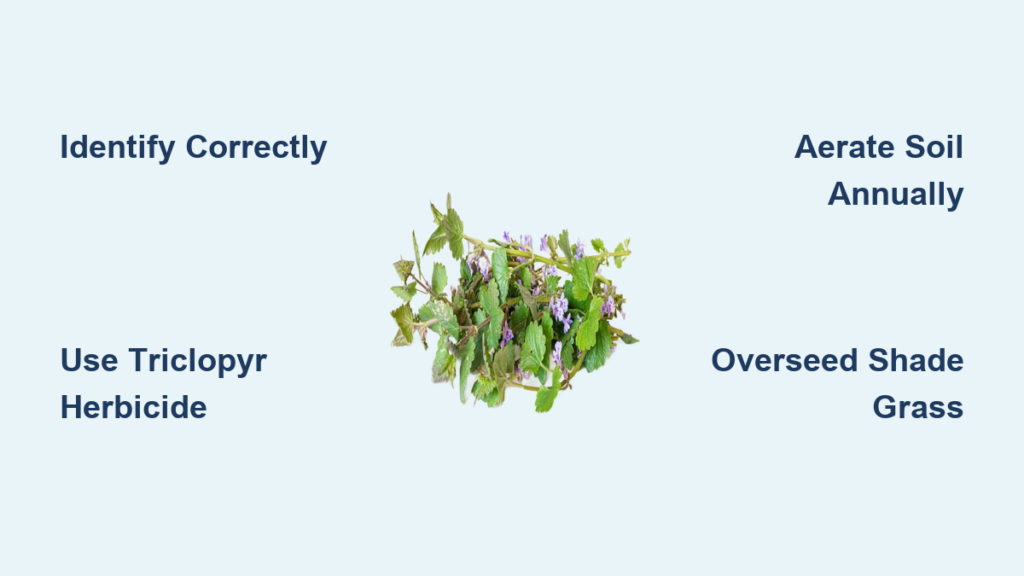
Creeping Charlie (Glechoma hederacea) is one of the toughest lawn invaders you will ever face. This low-growing, evergreen perennial spreads aggressively through stolons and rhizomes, forming dense mats that choke out grass, especially in shady, moist, compacted areas. Originally brought from Europe for medicinal uses, it is now a widespread weed across North America, notorious for resisting common herbicides and regrowing from the tiniest plant fragments.
If you have seen glossy, round leaves with scalloped edges creeping across your yard, emitting a minty smell when crushed, you are likely dealing with creeping Charlie. This guide gives you a proven, step-by-step plan to eliminate it using science-backed herbicides, mechanical methods, and long-term lawn care strategies. You will learn when to spray, what products work best, and how to prevent regrowth.
Identify Creeping Charlie Accurately
Before treating, confirm you are targeting the right plant. Misidentification leads to wasted effort and damaged turf.
Look for Key Visual Clues
Creeping Charlie has distinct features that separate it from similar weeds. Focus on these characteristics when identifying the plant in your lawn.
The leaves are round to kidney-shaped, dark green, and glossy with scalloped edges. The stems are square-shaped, which is a hallmark of the mint family, and they root at nodes when they touch soil. The flowers are bluish-purple and funnel-shaped, appearing in spring. The most reliable identifier is the smell: crush a leaf and it gives off a strong minty odor.
Distinguish From Common Imposters
Several weeds look similar to creeping Charlie but have key differences.
• Wild Violet has heart-shaped leaves, no square stems, and no mint scent
• Henbit has round leaves but on fuzzy, round stems with pink flowers
• Purple Dead Nettle has fuzzy, triangular leaves and grows upright, not in mats
Use a hand lens if needed. Focus on stem shape and scent, as these are the most reliable identifiers.
Apply Triclopyr-Based Herbicides

Triclopyr is the most effective herbicide for killing creeping Charlie to the root. Unlike 2,4-D alone, triclopyr penetrates the waxy leaf surface and moves into the root system for complete kill.
Choose the Right Product
Opt for herbicides containing triclopyr as the primary active ingredient. Products with triclopyr combined with 2,4-D, dicamba, and MCPP offer broad-spectrum control.
Recommended products include T-Zone (triclopyr amine), which is highly effective and grass-safe. Ortho Weed-B-Gon Chickweed, Clover & Oxalis Killer contains triclopyr and works well on small patches. Speed Zone offers fast-acting control ideal for large infestations. Avoid generic weed and feed products, as they often lack sufficient triclopyr concentration.
Spray in Fall for Maximum Impact
The best time to apply triclopyr-based herbicides is late September to early November. During fall, creeping Charlie translocates nutrients and herbicides down to its roots, increasing kill rates significantly.
The secondary application window is mid-spring, just before or during flowering. Avoid summer applications, as heat stress can damage your lawn and reduce herbicide effectiveness.
Use Proper Application Technique
For effective coverage, follow these mixing and application guidelines.
Mix 1.2 to 1.5 ounces of T-Zone per gallon of water per 1,000 square feet. Use up to 5 gallons of water per 1,000 square feet to penetrate thick mats. Apply with a tank sprayer or backpack sprayer for precision. Use a fan-tip nozzle to minimize drift and ensure even coverage.
Spot-treat small patches or blanket-spray large infestations based on the extent of spread.
Repeat Treatments as Needed
One application is rarely enough. Follow this treatment schedule for the best results.
First spray should occur in late fall. Second spray should follow 3 to 4 weeks later. Check results by waiting 2 to 3 weeks and reapply if no dieback is visible. Some lawns require two consecutive fall treatments over two years for full control.
Combine Herbicides With Cultural Lawn Care
:max_bytes(150000):strip_icc()/how-to-kill-creeping-charlie-2131200_FINAL-06824d80a0584ca6b7212f5f51bcb561.png)
A healthy lawn is your best defense against creeping Charlie. This weed thrives where grass fails, especially in shade, compaction, and poor drainage areas.
Mow High and Regularly
Set mower height to 3 to 4 inches. Taller grass shades soil, blocking weed germination. Mow weekly during the growing season to prevent flowering and seed production. Sharp blades ensure clean cuts and reduce disease risk.
Aerate Compacted Soil Annually
Compaction favors creeping Charlie over healthy grass. Use core aeration every fall to improve soil conditions.
Rent a plug aerator that removes soil cores. Aerate when soil is moist but not soggy. Overseed immediately after aeration to fill gaps. This improves air, water, and nutrient flow to grass roots.
Fertilize Strategically
Apply 3 to 4 pounds of nitrogen per 1,000 square feet annually, split into three applications. Apply the first dose in late April or May. Apply the second dose in September. Apply the third dose in late October or early November.
Use slow-release fertilizers for consistent feeding. Consider gypsum to improve soil structure without altering pH.
Overseed With Shade-Tolerant Grass
After killing creeping Charlie, reseed bare spots with grass varieties that thrive in challenging conditions. Fine fescue excellent for shade. Tall fescue offers drought and traffic tolerance. Perennial ryegrass provides fast establishment.
For eco-friendly lawns, microclover can be mixed in, but it may not outcompete regrowing creeping Charlie.
Avoid Risky DIY Remedies
Many home remedies promise results but often do more harm than good. Stick with science-backed approaches for safe and effective control.
Skip the Borax Treatment
Despite viral tips online, borax is not recommended for creeping Charlie control. Boron toxicity can sterilize soil, killing grass, shrubs, and trees. The effects are long-lasting because boron does not break down. Over-application may require topsoil replacement 2 to 3 feet deep.
Iowa State University once published a borax recipe, but many extension services now discourage its use due to high risk of soil damage.
Do Not Rely on Household Vinegar
Household 5% white vinegar is ineffective against established creeping Charlie. Horticultural vinegar at 20 to 30% can burn foliage but rarely kills the roots. Either requires repeated applications and is non-selective, killing grass and flowers too.
Cornell University found vinegar suppresses growth over time but is not a standalone solution.
Use Mechanical Removal Carefully
Hand-pulling and dethatching can help, but only if done correctly to avoid spreading the weed further.
Hand-Pull Small Patches After Rain
This method works best for garden edges or minor infestations. Water soil first to loosen roots. Grab stems at the base and pull upward slowly. Remove every fragment, as leftover pieces regrow easily.
Dispose of plants in the trash. Do not compost them, as fragments can survive and reinfest your lawn.
Avoid Dethatching Rakes in Fall
While tempting, aggressive raking fragments creeping Charlie, spreading it further. It also damages recovering turf. Dethatching is best used after herbicide treatment to remove dead debris.
If you must rake, follow with overseeding to prevent reinvasion.
Smother Large Infestations
For severe cases, smothering kills all vegetation, including creeping Charlie. This is a last-resort method but effective for complete eradication.
Use Black Plastic for Complete Kill
Follow these steps for effective smothering.
Mow the area short. Cover with heavy-duty black plastic. Secure edges with rocks or stakes. Leave in place 6 to 12 weeks during hot summer months.
Sun heats the soil, cooking roots and seeds. This method is non-selective, so grass will die too. Plan to reseed the area after treatment.
Try Cardboard and Mulch for Smaller Areas
This eco-friendly alternative works well for patches in garden beds or shaded corners.
Lay 6 to 8 layers of cardboard over the patch. Cover with 3 to 4 inches of mulch. Keep moist to block light and speed decomposition.
Consider Acceptance in Problem Areas
In heavily shaded, moist zones where grass will not grow, eradication may be unrealistic. Some homeowners choose to adapt rather than fight.
Use Creeping Charlie as Ground Cover
Some gardeners give up on eradication and thrive with creeping Charlie as a ground cover. It is low-maintenance and stays green all season. It handles dog traffic and foot traffic better than grass. It prevents soil erosion on slopes or near ponds.
Just keep it contained to avoid spreading to neighbors yards.
Plant Alternatives That Compete
Replace creeping Charlie with more desirable ground covers that can compete effectively. Wild violets are pollinator-friendly and less aggressive. Creeping thyme is sun-loving and fragrant. Allelopathic fescues naturally suppress weeds.
One gardener reported that after T-Zone treatment, clover and violets took over with no creeping Charlie returning.
Monitor and Prevent Regrowth
Elimination takes time. Most successful plans span 2 to 3 years of consistent follow-up and maintenance.
Inspect Monthly for New Patches
Check these common invasion zones regularly. Inspect along fence lines. Check under trees. Look near downspouts or shaded walkways.
Spot-treat immediately with triclopyr to stop spread before it establishes.
Improve Drainage in Wet Zones
Reducing moisture makes the environment less hospitable to creeping Charlie. Install French drains. Create dry creek beds. Build rain gardens with native plants.
Avoid Herbicide Drift
Never spray on windy days. Triclopyr can damage tree roots, especially oaks and maples. It can harm ornamental shrubs and garden plants.
Use a shielded sprayer near borders to prevent drift damage.
Frequently Asked Questions About Removing Creeping Charlie
When is the best time to apply herbicide for creeping Charlie?
The optimal time is late September to early November, when creeping Charlie translocates nutrients and herbicides down to its roots. A secondary window exists in mid-spring just before or during flowering.
Does creeping Charlie come back every year?
Yes, creeping Charlie is a perennial weed that survives year-round. It regrows from roots and rhizomes, making complete eradication difficult without multiple treatments and long-term lawn care improvements.
Will borax kill creeping Charlie?
While borax can kill creeping Charlie, it is not recommended. The boron concentration required is dangerously close to levels that sterilize soil, killing grass, shrubs, and trees. Damage can be long-lasting and may require deep topsoil replacement.
What herbicide kills creeping Charlie permanently?
Triclopyr-based herbicides like T-Zone offer the best permanent control. These penetrate the root system for complete kill. Multiple applications are usually necessary, and combining herbicide treatment with cultural lawn care provides the best long-term results.
Can I overseed after killing creeping Charlie?
Yes, overseeding is essential after treatment. Wait 2 to 3 weeks after the final herbicide application, then seed bare spots with shade-tolerant grasses like fine fescue. This fills gaps and prevents creeping Charlie from reinvading.
Is creeping Charlie harmful to pets?
Creeping Charlie contains compounds that can be toxic to liver and kidneys if consumed in large quantities. While pets typically avoid it due to the minty smell, caution is advised. Consult a veterinarian if your pet shows interest in eating the plant.
Key Takeaways for Eliminating Creeping Charlie

Creeping Charlie is a persistent weed that requires a multi-year strategy combining chemical and cultural approaches. The most effective method is fall application of triclopyr-based herbicides like T-Zone or Speed Zone, applied 3 to 4 weeks apart for maximum root penetration.
Avoid risky home remedies like borax, which can sterilize your soil, and household vinegar, which rarely kills the root system. Instead, focus on building a healthy lawn through proper mowing height, annual aeration, strategic fertilization, and overseeding with shade-tolerant grass varieties.
For severely infested areas where grass refuses to grow, consider accepting creeping Charlie as a low-maintenance ground cover or replacing it with alternatives like wild violets or creeping thyme. Monitor your lawn monthly for new patches, improve drainage in wet zones, and avoid herbicide drift to protect trees and ornamentals.
With patience and consistent effort over 2 to 3 years, you can reclaim your lawn from this tenacious invader.