If your lawn looks patchy, pale, or struggles to recover from foot traffic, the solution might not be more mowing or watering. It could be fertilization timing. The secret to lawn health is not just how often you fertilize, but when you apply nutrients. Most homeowners make the mistake of feeding their grass in spring and forgetting it by fall, but the most effective fertilization strategy follows the grass’s natural growth cycle, not the calendar.
For cool-season grasses like Kentucky bluegrass or tall fescue, the prime feeding window is late summer to fall, when roots are actively growing. For warm-season grasses like Bermuda or Zoysia, peak nutrition should come in late spring and summer, during their active growing season. Applying fertilizer at the wrong time can lead to stress, disease, or even burn.
This guide breaks down exactly how often to use fertilizer on your lawn based on your grass type, the season, and your local climate. You will learn the ideal number of annual applications, how to read your lawn’s signals, and how to avoid over or under feeding.
Know Your Grass Type First
Before deciding how often to fertilize, you must identify whether you have cool-season or warm-season grass. This single factor determines your entire fertilization schedule.
Cool-Season vs Warm-Season Grasses
Cool-season grasses include Kentucky bluegrass, perennial ryegrass, tall fescue, and fine fescue. These varieties grow most actively in spring and fall, and they go dormant during summer heat and winter cold. The best strategy for these grasses is to fertilize heavily in fall and lightly in spring, while avoiding summer feeding entirely.
Warm-season grasses include Bermuda, Zoysia, St. Augustine, and centipede. These thrive in heat and green up in late spring, then go dormant in fall. For these grasses, the prime feeding window spans late spring through summer, starting after full green-up and stopping by early fall.
If you live in the northern United States, Canada, or the Pacific Northwest, you likely have cool-season grass. In the South and Southwest, warm-season grass dominates.
Ideal Fertilization Frequency

How many times per year should you feed your lawn? The answer depends on your goals and your grass type.
Three to Four Times Per Year: Standard Schedule
For most lawns, three to four applications annually strike the perfect balance between health and effort. This schedule supports strong roots, deep color, and weed resistance without overstimulating growth.
For cool-season lawns, apply in early spring, late spring, early fall (the most important application), and late fall for winterizing. For warm-season lawns, apply in late spring after green-up, mid-summer, and optionally in early fall.
If you only fertilize once a year, make it in early fall. This single feeding does more for long-term lawn health than any other application.
One to Two Times Per Year: Low-Maintenance Approach
For basic lawn health, fall-only or spring-plus-fall feeding is sufficient. This approach works well for established tall fescue lawns, low-traffic yards, and homeowners who prefer minimal upkeep.
A single fall feeding builds root strength and boosts spring green-up more effectively than spring-only fertilization.
Four to Six Times Per Year: High-Performance Lawns
For premium lawns with Kentucky bluegrass or in high-traffic areas, four to six applications keep turf thick and resilient. Use slow-release fertilizers and time applications every six to eight weeks during active growth. Include summer feeding for warm-season grasses.
Frequent feeding requires consistent mowing and watering. Otherwise, you risk thatch buildup or disease.
Seasonal Fertilization Schedule
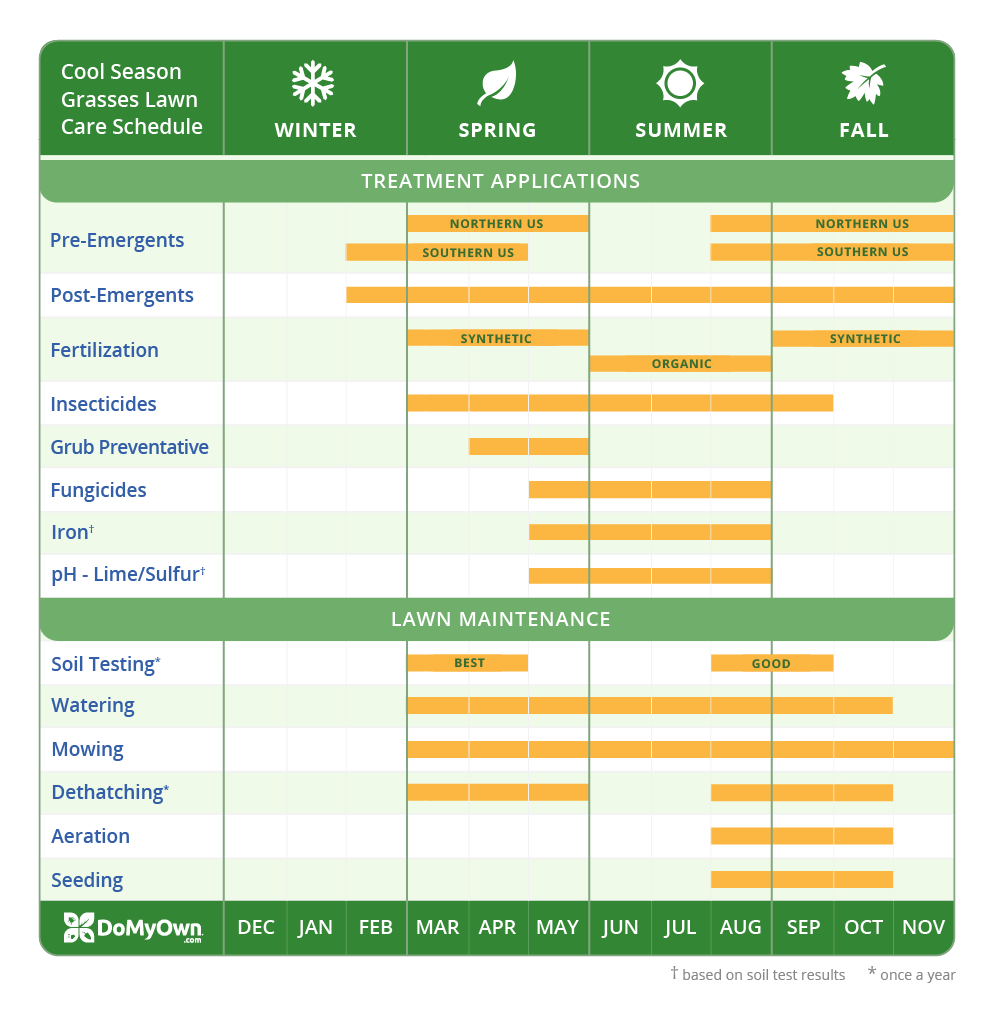
Timing is everything. Here is when to feed your lawn, broken down by season.
Early Spring Feeding
Apply early spring fertilizer between February and April, after two to three mowings. This kickstarts growth, strengthens roots, and helps prevent weeds. Use 0.5 to 1 pound of nitrogen per 1,000 square feet.
For cool-season lawns, use a balanced fertilizer or one with crabgrass preventer. For warm-season lawns, wait until full green-up when soil temperature exceeds 65 degrees Fahrenheit. Premature feeding encourages weeds instead of grass.
Avoid fertilizing too early. Grass needs active growth to absorb nutrients effectively.
Late Spring Boost
Apply six to eight weeks after early spring feeding. This sustains peak growth, fills in thin spots, and supports root development. Use 0.5 to 1 pound of nitrogen per 1,000 square feet.
For cool-season lawns, use weed-and-feed if broadleaf weeds are present. For warm-season lawns, apply a high-nitrogen fertilizer to support summer growth.
Do not fertilize cool-season grass if temperatures exceed 73 degrees Fahrenheit. The risk of burn increases significantly.
Summer Feeding: Proceed with Caution
Apply six to eight weeks after late spring feeding. This combats heat stress and supports recovery from foot traffic.
For cool-season lawns, avoid standard fertilizers. Only use summer-specific blends with slow-release nitrogen and insect or fungal protection. For warm-season lawns, this is prime feeding time. Apply every six to eight weeks.
Never fertilize drought-stressed or dormant grass. Water first, then feed.
Fall: The Most Important Feeding
Apply between August and November, before dormancy. This repairs summer damage, stores nutrients, and strengthens roots for winter.
For cool-season lawns, apply six to eight weeks after summer feeding while grass is still green and growing. For warm-season lawns, this is an optional early fall application. Avoid late applications.
Fall fertilization is the single most impactful application of the year for cool-season lawns.
Late Fall Winterizer Application
Apply one to two weeks after final mowing, before ground freezes. This winterizes the lawn and boosts cold tolerance and disease resistance.
Use a winterizer fertilizer high in nitrogen and potassium. Some professionals apply winterizer twice, once around Labor Day and again six to eight weeks later.
Nitrogen: The Key Nutrient
Nitrogen drives green growth and lawn density. Managing it properly prevents burn and waste.
Annual Nitrogen Needs
Full-sun lawns need 2 to 3 pounds of nitrogen per 1,000 square feet per year. Shade lawns need 1 to 1.5 pounds. Cool-season lawns need 0.5 to 0.9 pounds annually, split between spring and fall.
Per-Application Nitrogen Limits
For fast-release fertilizers, never exceed 1 pound of nitrogen per 1,000 square feet per application. Slow-release fertilizers can exceed this amount due to gradual release. For frequent feeding every two to four weeks, use 0.25 to 0.5 pounds of nitrogen to avoid burn.
How to Calculate Fertilizer Amount
Use this formula. First, divide your desired nitrogen rate by the percentage of nitrogen in the bag. Then multiply by your lawn area divided by 1,000.
For example, using a 15-0-10 fertilizer on a 7,000 square foot lawn at 1 pound nitrogen per 1,000 square feet: divide 1 by 0.15 to get 6.67, then multiply by 7 to get approximately 46.7 pounds of fertilizer needed.
Choose the Right Fertilizer Type
Not all fertilizers are the same. Picking the right type affects how often you need to apply.
Fast-Release vs Slow-Release
Fast-release fertilizers like urea provide quick greening and work well for spot recovery. Apply every four to six weeks. Slow-release fertilizers like polymer-coated options provide routine feeding and prevent burn. Apply every six to twelve weeks.
Use slow-release for 90% of your applications. It feeds grass steadily and reduces risk.
Specialty Fertilizers
Winterizer fertilizers are high in nitrogen and potassium. Use in fall for cold protection. Weed-and-feed combinations work best in fall for post-emergent control. Starter fertilizers are high in phosphorus. Use only for new lawns or if soil tests show low phosphorus. Organic fertilizers release slowly, improve soil health, and carry no burn risk.
Avoid fertilizers with sewage sludge, as they can introduce toxins.
Signs You Are Over- or Under-Fertilizing
Your lawn tells you when something is wrong. Learn to read the signals.
Over-Fertilization Signs
Watch for fertilizer burn appearing as brown, crispy tips or patches. Excessive growth requiring mowing every three to four days indicates too much feeding. Dark, unnatural green color, thatch buildup, and increased disease or pest issues also signal over-fertilization.
To fix this, water deeply to flush salts and stop feeding for six to eight weeks.
Under-Fertilization Signs
Pale or yellow grass during the growing season indicates nutrient deficiency. Thin, weedy turf, slow recovery from damage, and poor color despite watering are also warning signs.
Note that brown patches may indicate grubs or disease, not nutrient deficiency. Test before assuming.
Best Practices for Healthy Feeding
Follow these expert-backed rules to fertilize safely and effectively.
Test your soil every two to three years. A soil test reveals nutrient levels and pH, preventing over-application of phosphorus or potassium. Many lawns already have high phosphorus, and adding more wastes money and harms waterways.
Never exceed 1 pound of nitrogen per 1,000 square feet. This rule prevents burn, especially with fast-release fertilizers. If you want more frequent feeding, use lower rates.
Always water in fertilizer within 24 hours. This activates nutrients and reduces burn risk. However, avoid fertilizing before heavy rain because runoff pollutes water systems.
Mow high and mulch clippings. Cut no more than one-third of blade height. Leave clippings because they return approximately 25% of nitrogen to the soil. Maintain three to three-and-a-half inch height for deeper roots.
Do not fertilize stressed lawns. Avoid feeding during drought, extreme heat above 73 degrees Fahrenheit for cool-season grasses, dormancy, or disease or grub infestations.
Adjust for Soil and Climate
Your lawn needs depend on local conditions.
Sandy vs Clay Soils
Sandy soils drain quickly and nutrients leach fast. Use more frequent, lighter applications. Clay soils hold nutrients longer, so fewer applications are needed.
Regional Adjustments
In the Northeast and Midwest, cool-season grasses dominate. Fertilize in spring, early fall, and late fall. In the South and Southwest, warm-season grasses prevail. Feed from late spring through summer. The Pacific Northwest is similar to the Northeast, where fall feeding is key.
With hotter summers, some gardeners delay spring feeding and focus on early fall.
Frequently Asked Questions About Fertilizing Your Lawn
What happens if I fertilize my lawn too often?
Over-fertilizing causes fertilizer burn, excessive growth, thatch buildup, and increased disease susceptibility. Brown patches appear, and you may need to stop feeding for six to eight weeks while watering deeply to flush excess salts.
Can I fertilize my lawn in summer?
For cool-season grasses, avoid standard fertilizers during summer heat. Only use specialized summer blends if needed. For warm-season grasses, summer is the prime feeding time. Apply every six to eight weeks during active growth.
How do I know if my lawn needs fertilizer?
Look for pale or yellow grass during the growing season, thin turf with weeds, slow recovery from foot traffic, and poor color despite adequate watering. A soil test provides the most accurate assessment of nutrient needs.
Is fall really the most important time to fertilize?
Yes, for cool-season grasses, fall fertilization is the most impactful application of the year. It strengthens roots, stores nutrients for winter, and promotes vigorous spring green-up. Even a single fall feeding outperforms multiple spring-only applications.
How long should I wait between fertilizer applications?
Wait six to eight weeks between standard applications. If using lower nitrogen rates, you can apply more frequently, such as every two to four weeks during peak growing season for warm-season grasses.
Can I use the same fertilizer year-round?
No. Different seasons require different formulations. Use high-nitrogen fertilizers in spring and summer, switch to fall fertilizers with more potassium for winter hardiness, and apply winterizer blends late in the season.
Key Takeaways for Fertilizing Your Lawn
Fertilizing is not about frequency. It is about timing, fertilizer type, and total nitrogen management. Match your schedule to your grass type, use slow-release formulas for most applications, and prioritize fall feeding if you have cool-season grass.
For most lawns, three to four applications per year provide the best balance. Apply in early spring, late spring, early fall, and late fall for cool-season grasses. For warm-season grasses, apply in late spring, summer, and optionally early fall.
Always follow the one-pound nitrogen per 1,000 square feet rule to prevent burn. Test your soil every few years, water after applying, and never feed stressed or dormant grass.
With the right approach, you will grow a lawn that is green, thick, and built to last.