If your lawn turns into a sticky mess after rain or bakes into a rock-hard surface during dry spells, you are likely dealing with clay soil. While dense and stubborn, clay soil can support a lush, green lawn, but only with the right care. The key is not a one-time fix but a consistent, long-term strategy that improves structure, drainage, and root development over 2 to 3 years. This guide reveals proven methods, from core aeration to compost topdressing, that transform heavy clay into healthy turf. You will learn what works, what to avoid, and how to build a resilient lawn that thrives year-round.
Core Aeration: Break Soil Compaction
Clay soil packs tightly, suffocating grass roots and blocking water and air. Aeration is the most effective way to relieve this pressure and open pathways for improvement.
Why Core Aeration Beats Spike Aeration
Spike aerators poke holes but compress surrounding soil, worsening compaction in clay. Core (plug) aeration removes small cylinders of soil, instantly reducing density and creating space for roots, oxygen, and amendments to penetrate.
Best time to aerate: Early fall or early spring, when grass is actively growing and soil moisture is moderate. Avoid aerating when soil is too wet (it smears and clumps) or bone dry (too hard to penetrate). Ideal conditions: soil damp like a wrung-out sponge.
Choose the Right Aerator
• Manual aerators (sandals, hand tools): Only for small patches. Limited depth and coverage.
• Walk-behind core aerators: Rentable for $50 to $100 per day. Best for medium to large lawns. Look for models with 3/4 inch to 3/8 inch tines, 2 to 4 inches deep.
• Tow-behind units: For large yards. May struggle in sticky, saturated clay.
Pro Tip: Overlap passes by 50% for full coverage. If plugs do not form, soil is too dry or wet. Wait and try again.
How Often to Aerate
Once per year is standard for most clay lawns. Twice yearly (spring and fall) speeds improvement in severely compacted areas. After aeration, leave the soil plugs on the lawn. They break down naturally in 1 to 2 weeks, returning microbes and nutrients. Rake lightly if needed, but do not remove them.
Topdressing with Compost: Build Better Soil

Aerating opens the door. Topdressing with compost walks through it. This step delivers organic matter directly into the root zone, improving texture, drainage, and biology.
Best Materials for Topdressing
• High-quality compost: Top choice. Adds nutrients, feeds microbes, and improves structure.
• Aged manure: Rich in organic matter and nutrients. Source from local farms. Never use fresh manure.
• 50/50 topsoil-compost blend: Use only for leveling low spots.
Never use sand, peat moss, or wood chips on clay lawns. Sand can create concrete-like soil. Peat compacts and repels water. Wood chips rob nitrogen as they break down.
Apply Correctly to Avoid Smothering Grass
- Aerate first.
- Spread a thin layer (1/4 to 1/2 inch) of compost evenly.
- Use a stiff rake, broom, or drag mat to work material into aeration holes.
- For large lawns, use a compost spreader for even distribution.
Warning: More than 1/2 inch can suffocate grass and encourage thatch buildup.
How Often to Topdress
Once per year (after aeration) is ideal. For fast results, apply twice yearly (spring and fall). Over time, annual topdressing builds a looser, crumbly soil structure that supports deeper roots and faster drainage.
Gypsum Application: Unlock Soil Structure
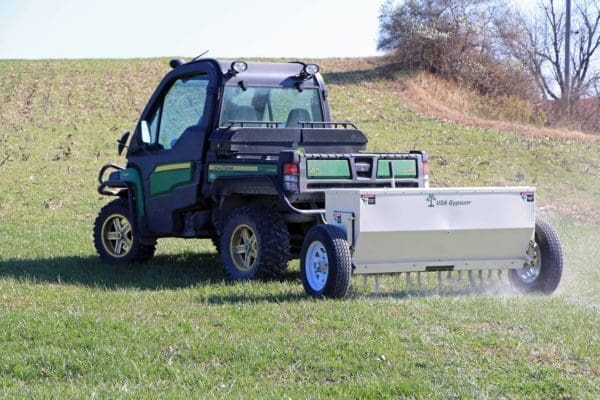
Gypsum does not change pH, but it flocculates clay particles, clumping them into aggregates that create pore space for air and water.
How Gypsum Works
Calcium in gypsum displaces sodium ions (common in clay from road salt or irrigation). This promotes stable soil clumps, improving drainage, root penetration, and microbial activity. Effects build over months, not instantly, but are cumulative.
Apply Gypsum the Right Way
• Rate: 20 to 40 pounds per 100 square feet (follow label).
• Method: Use a broadcast spreader for even coverage.
• Timing: Apply after aeration, once or twice per year.
• Water in thoroughly to activate.
Liquid Gypsum: Fast-Acting Supplement
Products like OMX Liquid Gypsum penetrate quickly and work well on sodic (sodium-rich) soils. Safe to use even if sodium levels are unknown. Apply as a booster alongside granular gypsum.
Myth Busting: Gypsum does not alter pH. Lime raises pH. Gypsum improves structure without affecting acidity.
Organic Fertilizers: Feed Soil and Grass
Chemical fertilizers feed plants but ignore soil health. In clay, organic fertilizers do both, releasing nutrients slowly while building long-term fertility.
Top Organic Fertilizers for Clay Lawns
• Milorganite: High in nitrogen and iron. Promotes deep green without burn. Apply 5 times per year.
• Bone meal: Rich in phosphorus. Strengthens roots. Ideal for fall application.
• Aged manure-based fertilizers: Provide balanced nutrition and organic matter.
Fertilization Schedule
| Time of Year | Action |
|---|---|
| Spring | Apply Milorganite to kickstart growth |
| Every 30 days | Reapply Milorganite through growing season |
| Fall | Use high-phosphate organic feed to winterize roots |
Avoid synthetic fertilizers alone. They offer short-term greening but do nothing to improve clay structure.
Overseed with Clay-Tolerant Grasses
Even with improved soil, your lawn needs the right grass to thrive. Choose varieties that tolerate compaction, moisture swings, and shade.
Best Grass Types for Clay Soil
• Perennial ryegrass: Fast-establishing, wear-resistant, handles compaction.
• Fine fescue: Drought and shade tolerant. Needs less mowing.
• Tall fescue: Deep roots, heat and drought resistant. Ideal for heavy traffic.
Use a blend of these species for resilience across conditions.
When and How to Overseed
Best time: Early fall, right after aeration and topdressing. Alternative: Spring, less ideal due to weed competition.
Steps:
1. Aerate and topdress.
2. Spread seed with a broadcast spreader (set to medium rate).
3. Keep soil consistently moist until germination (3 to 4 weeks).
4. Avoid walking on new seedlings.
Visual cue: Grass should sprout in 10 to 14 days under ideal conditions. Patchy emergence means poor seed-to-soil contact or dry spells.
Seasonal Treatment Plan
Stick to a yearly rhythm to see real change. Progress builds over time, each season compounding the last.
Winter: Test and Plan
Test soil pH (ideal: 5.5 to 7.0). If pH is low (acidic), apply lime. Plan spring aeration, compost, and overseeding. Test every 3 to 4 years for detailed nutrient and sodium analysis.
Spring: Aerate and Rebuild
Core aerate when soil is moist but not wet. Topdress with 1/4 to 1/2 inch compost. Apply organic fertilizer (e.g., Milorganite). Overseed bare spots. Optional: Apply soil conditioner (e.g., humic acid).
Summer: Protect and Maintain
Mow high (3 to 4 inches) to shade roots and reduce moisture loss. Water deeply but infrequently (1 to 1.5 inches per week). Avoid walking on wet lawn. Mulch clippings (grasscycling returns nutrients).
Autumn: Optimize for Growth
Core aerate (best time of year). Topdress with compost. Overseed with clay-tolerant grasses. Apply high-phosphate organic fertilizer to strengthen roots. Mulch leaves weekly with mower. Bag only if layer exceeds 6 inches.
Critical Tip: Do not let leaves sit. A thick mat blocks light, causes mold, and kills grass.
What NOT to Do: Avoid These Mistakes
Even with good intentions, common mistakes can make clay soil worse.
Adding Sand to Clay
Myth: Sand loosens clay. Reality: Sand plus clay equals adobe or concrete when wet. This mixture is harder to fix than pure clay. Use compost, not sand.
Using Wood Chips on Lawn
Wood chips decompose slowly, consuming nitrogen in the process. Grass turns pale and weak. Use wood chips only in garden beds. On lawns, use compost.
Letting Clay Dry Out
Dry clay forms a hard crust that blocks water and new seedlings. Keep soil consistently moist, especially after seeding.
Mowing Too Short
Short mowing exposes soil, increases evaporation, and stresses grass. Mow at 3 to 4 inches to promote shade and moisture retention.
Overwatering
Clay already holds water. Extra watering leads to puddles, root rot, and moss. Water deeply once or twice a week, not daily.
Tilling Wet Clay
Working clay when wet destroys its structure and causes compaction. Wait until soil is moist but not sticky before any mechanical work.
Relying on Chemical Fertilizers
Synthetics feed grass but ignore soil biology. Combine chemical feeds with organic matter and aeration for lasting results.
Smothering with Leaves
A thick leaf layer blocks sunlight and air, promoting mold and killing grass. Mulch leaves weekly with a mower. Shred them into dime-sized pieces.
Long-Term Benefits: What to Expect
With 2 to 3 years of consistent care, your clay lawn will transform.
Signs of Improvement
• Soil feels crumbly, not sticky or hard.
• Water soaks in within 1 to 2 hours (was 4-plus hours).
• Fewer puddles and wet spots after rain.
• More earthworms, a sign of healthy soil biology.
• Grass greens up faster in spring.
• Less moss and weeds.
• New grass establishes easily.
• Clippings decompose quickly.
Bottom Line: Healthy clay soil becomes self-sustaining, needing less water, fertilizer, and maintenance.
Economical and Sustainable Methods
You do not need expensive products to fix clay soil. The best improvements are often free or low-cost.
| Method | Cost | Effectiveness | Notes |
|---|---|---|---|
| DIY compost | Free | High | Use kitchen scraps, leaves, grass clippings |
| Leaf mulching | Free | High | Mow leaves into lawn weekly |
| Aged manure | Low (often free) | High | Rich in nutrients and organic matter |
| Gypsum (bulk) | Low to moderate | Medium-High | Best with compost |
| Cover crops | Low | Medium | Use during renovation (e.g., clover, ryegrass) |
| Core aeration (rental) | $50 to $100/day | High | Most impactful single action |
| Liquid humic acid | Moderate | Medium | Enhances nutrient uptake |
Sustainable Strategy: Combine free organic matter (leaves, clippings, compost) with annual aeration and gypsum. This builds soil from within, no synthetic shortcuts needed.
Frequently Asked Questions About Treating Clay Soil Lawn
How long does it take to improve clay soil for lawn?
Improving clay soil is a multi-year commitment. Most homeowners see noticeable improvement after 1 to 2 years of consistent treatment. Significant transformation typically occurs over 2 to 3 years with annual aeration, compost topdressing, and gypsum application.
Can I add sand to improve clay soil lawn?
No. Adding sand to clay soil creates a concrete-like mixture (adobe) that is harder to fix than pure clay. Use compost instead. Organic matter breaks up clay particles naturally without creating compaction problems.
When is the best time to aerate clay soil lawn?
Early fall is ideal because cooler temperatures allow grass to recover while soil is still warm. Early spring works well too, before peak summer heat. Avoid aerating when soil is too wet (causes smearing) or too dry (too hard to penetrate).
Does gypsum really help clay soil?
Yes. Gypsum flocculates clay particles, causing them to clump into aggregates that create pore space for air and water. It improves drainage and root penetration without changing soil pH. Effects build gradually over months with repeated applications.
What grass grows best in clay soil?
Perennial ryegrass, fine fescue, and tall fescue all tolerate clay conditions well. Perennial ryegrass establishes quickly and handles wear. Fine fescue thrives in shade and drought. Tall fescue develops deep roots for heat and drought resistance.
How often should I topdress my clay lawn with compost?
Once per year after aeration is ideal. For faster results in severely compacted areas, apply twice yearly (spring and fall). Never exceed 1/2 inch thickness, as thicker layers can smother grass and create thatch.
Key Takeaways for Transforming Your Clay Soil Lawn
Clay soil presents real challenges, but it also holds significant advantages. Its high nutrient and water retention capacity becomes an asset once structure improves through consistent care. The foundation of any successful treatment plan is core aeration, which physically relieves compaction and creates pathways for amendments to reach the root zone. Combine aeration with annual compost topdressing to build organic matter, and apply gypsum to promote soil aggregation. Feed your lawn with organic fertilizers that nurture both grass and soil biology. Choose clay-tolerant grass varieties and overseed regularly to thicken turf. Avoid harmful shortcuts like adding sand, which creates worse problems. Stick to the annual cycle of aerate, topdress, apply gypsum, overseed, and fertilize with organic products. Patience is essential. Each year of consistent treatment brings measurable improvement. Your clay lawn can become the best foundation for a thriving, resilient, and self-sustaining landscape.