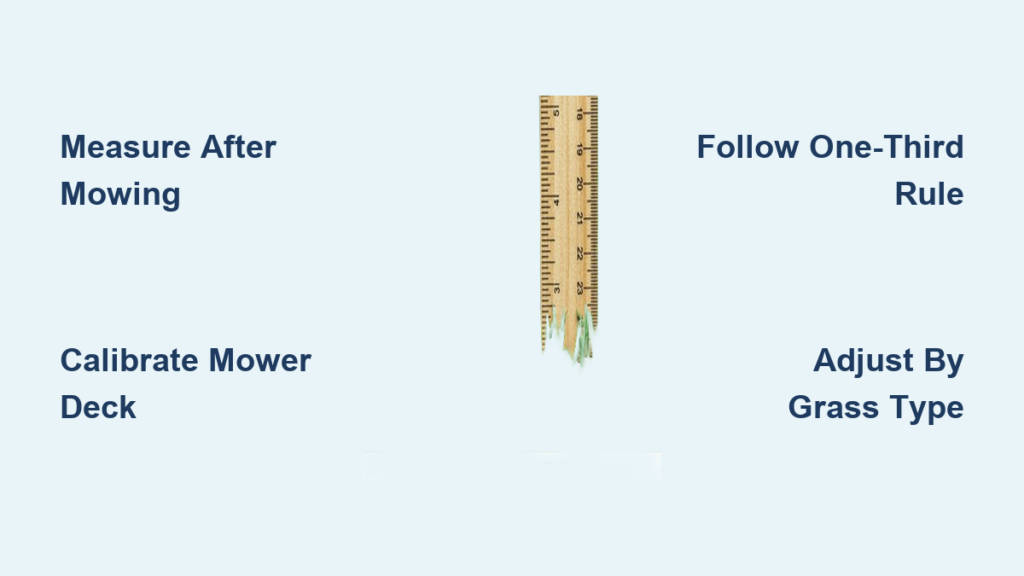
Mowing your lawn at the right height isn’t just about looks. It’s the foundation of a healthy, weed-resistant turf. Yet most homeowners rely on vague mower settings like “position 3” without knowing the actual grass height, leading to scalping, stress, and poor performance. The truth is that mower settings don’t equal cutting height. To truly care for your lawn, you need to measure the grass itself.
This guide shows you how to measure lawn height accurately using proven methods from turf professionals. You’ll learn the one-third rule, ideal heights by grass type, and why measuring after mowing is more reliable than trusting your mower’s dial. Whether you’re managing fescue in Ohio or St. Augustine in Florida, these techniques ensure your lawn stays thick, green, and resilient year-round.
Measure Grass After Mowing
The only way to know your true lawn height is to measure the grass after it’s cut. Mower settings are estimates. Real-world conditions like uneven terrain and deck tilt affect the final cut. Measuring post-mow gives you accurate, actionable data.
Stand Grass Upright Before Measuring
Before placing a ruler, gently lift the grass blades so they’re vertical. Lying or bent grass gives false low readings. Use your hand or a flat object like a notebook to coax the blades upward without compressing the soil.
Pro Tip: Measure in the morning when dew keeps blades flexible and easier to stand up straight.
Use a Ruler or Tape Measure
Place a rigid ruler or steel tape measure vertically from the soil surface to the tallest blade tip. Avoid soft measuring tapes because they bend and skew results.
Use inches for general use, millimeters for precision. Take 5 to 10 readings across different areas including high-traffic zones, shade spots, and open lawn. Calculate the average to determine your effective mowing height.
Visual Cue: If you see soil between blades, you’re likely cutting too short.
Avoid Slopes and Obstacles
Choose flat, representative areas. Avoid tree roots, curbs, driveway edges, and mound tops or valleys. These spots compress the mower deck or alter wheel height, creating misleading measurements.
Calibrate Your Mower’s Cutting Height
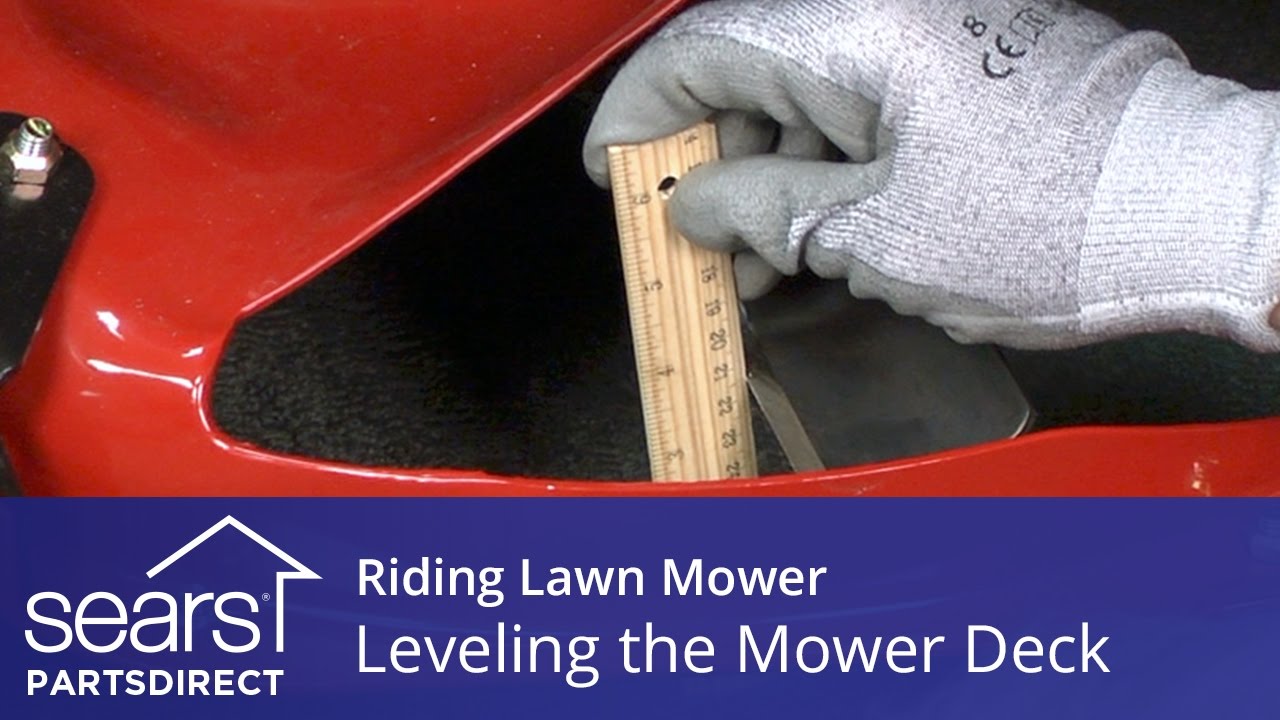
Your mower’s height dial may not match reality. A “4” setting doesn’t guarantee 4 inches. Calibration on a hard surface reveals what your mower actually cuts.
Test on a Flat Hard Surface
Park the mower on concrete or asphalt, never grass. Uneven ground or soft soil skews results.
Steps:
- Disconnect the spark plug for safety.
- Set the deck to your desired height such as “4.”
- Measure from the ground to the blade tip when it’s at its lowest point. Rotate blade to 90 degrees from axle.
- Repeat for all height settings.
Service Hack: Slide a popsicle stick under the blade. Let the blade mark it, then measure from base to mark for exact clearance.
Record Actual Heights
Create a personalized calibration chart. Label your mower with a paint pen or sticker showing the setting that delivers your target height.
| Setting | Actual Height (in) |
|---|---|
| 1 | 1.75 |
| 2 | 2.25 |
| 3 | 2.75 |
| 4 | 3.25 |
| 5 | 3.75 |
| 6 | 4.0 |
Real-World Finding: One Toro owner found their “4” setting cut at just 2.75 inches, a full 1.25 inches shorter than expected.
Use Professional Measurement Tools
For precision especially on sports fields or high-end lawns, specialized tools deliver millimeter accuracy.
Try an Optical Prism
Turf pros use optical prisms to measure grass height without touching the blades. Place the prism on the soil. Internal optics align and magnify the tips for exact readings.
Available in inch and mm scales. Detects blade bruising from dull mower blades. Standard on golf courses and stadiums.
Cost Note: A quality prism costs around $180, making it overkill for most homeowners.
Use a Lawn Ruler or Measuring Stick
Garden centers sell lawn rulers, durable pocket-sized tools marked in 0.25-inch increments. Simply place on soil and stand grass against it.
Quick field checks, durable for frequent use, ideal for tracking seasonal changes.
Alternative: Tape a ruler to a small board to prevent sinking into soft soil.
Know the One-Third Rule
Never remove more than one-third of the grass blade in a single mow. Exceeding this stresses the plant, weakens roots, and invites disease.
Apply the Rule Correctly
If your target height is 3 inches, mow when grass reaches 4.5 inches. For 4-inch lawns, cut at 6 inches. Cutting taller grass too short shocks the plant, causing yellowing and thinning.
Consequence: Violating the one-third rule reduces drought tolerance and increases crabgrass invasion even with pre-emergent herbicides.
Mow More Frequently in Peak Growth
During spring and early summer, grass grows fast. To avoid overcutting, mow every 5 to 7 days. Never wait until grass is twice the target height.
Pro Tip: If you can’t mow on schedule, raise the deck temporarily and gradually lower it over the next few cuts.
Set Height by Grass Type
The ideal height depends on species. Cool-season and warm-season grasses have different needs.
Fescue, Bluegrass, Ryegrass (Cool-Season)
| Season | Height (in) | Notes |
|---|---|---|
| Spring | 3.5 to 4 | Remove winter debris, slightly shorter start |
| Summer | 3.5 to 4 | Shade soil, retain moisture, block weeds |
| Fall | 3 to 3.5 | Prepare for dormancy |
| Winter | 2 (final cut) | Prevent snow mold |
Key Insight: Keep fescue at 4 inches in summer. It suppresses weeds and survives drought better.
Bermuda, St. Augustine, Zoysia (Warm-Season)
| Season | Height (in) | Notes |
|---|---|---|
| Spring | 2 to 2.5 | First cut removes dormancy residue |
| Summer | 2 to 4 | St. Augustine 3.5 to 4, Bermuda 0.5 to 2 |
| Fall | 2.5 to 3 | Build winter resilience |
| Winter | 2 (final cut) | Reduce disease risk |
Species-Specific Tips: St. Augustine thrives at 4 inches for shade tolerance and moisture retention. Bermuda flourishes at 1 to 2 inches. Centipede is sensitive, keep at 1.5 to 2 inches. Zoysia grows densely at 1 to 2 inches, avoid high cuts that encourage thatch.
Adjust Height by Season
Mowing needs change with the calendar. Matching height to season optimizes health and stress resistance.
Mow Higher in Summer
Tall grass shades the soil, reducing evaporation and heat stress. It also crowds out weeds like crabgrass.
Ideal range is 3 to 4 inches for most lawns. Avoid mowing during midday heat above 90 degrees Fahrenheit. Keep blades sharp to prevent tearing.
Research Finding: Lawns at 3.5 inches had significantly less crabgrass than those at 2 inches even with full herbicide rates.
Cut Shorter in Spring
Early-season mowing removes dead tissue and encourages new growth.
Cool-season grasses start at 3.5 inches, rise to 4 by summer. Warm-season grasses first cut at 2 inches once soil hits 55 degrees Fahrenheit.
Timing Tip: Don’t mow warm-season grass too early. Damaged blades won’t recover until growth resumes.
Prepare for Winter
Final mow of the year should be 2 inches, short enough to prevent snow mold, tall enough to protect plant crowns.
For warm-season grasses, raise height in fall to 2.5 to 3 inches before frost. Never leave grass tall and matted over winter.
Fix Common Mowing Height Errors

Even with the right settings, mechanical and environmental factors cause inconsistent cuts.
Level the Mower Deck
An unbalanced deck cuts unevenly, high on one side, scalped on the other.
Check Front-to-Back and Side-to-Side:
- Park on a level surface.
- Measure from blade tip to ground at front, rear, and both sides.
- Adjust using deck bolts until differences are 0.25 inch or less.
Pro Insight: One John Deere LA140 owner found their deck was 1 inch lower than settings indicated due to incorrect service adjustment.
Maintain Tire Pressure
Low tires compress, lowering the deck and causing scalping.
Check pressure monthly. Use manufacturer-recommended PSI. Replace worn or cracked tires.
Avoid Curbs and Edges
Running wheels on curbs or driveways drops the opposite side of the deck.
Keep all wheels on the same plane. Use a string trimmer for edges instead of lowering mower wheels.
Optimize Equipment and Routine
Healthy lawns start with well-maintained tools and smart habits.
Sharpen Mower Blades Regularly
Dull blades tear grass instead of cutting it, creating ragged tips that invite disease.
Sharpen twice per season, spring and midsummer. Replace if bent or chipped. Balance blades after sharpening.
Visual Clue: Brownish tips after mowing? Likely dull blades.
Create a Mowing Height Log
Track measurements and settings including date mowed, grass height average of 5 or more readings, mower setting used, and weather conditions.
Over time, this reveals growth patterns and helps fine-tune your schedule.
Educate Household Mowers
Ensure everyone who cuts the lawn knows the target height, the one-third rule, and where the calibration chart is.
Industry Trend: Lawn care companies now include mowing height clauses in contracts. Some even drop clients who mow too short.
Frequently Asked Questions About Measuring Lawn Height
What is the best way to measure lawn height accurately?
The most accurate method is to measure the grass itself after mowing. Use a rigid ruler or steel tape measure placed vertically from the soil surface to the tallest blade tip. Take 5 to 10 readings across different areas of your lawn and calculate the average. This accounts for real-world variability like uneven terrain and tire compression.
How often should I measure my lawn height?
Measure your lawn height every time you mow, at least initially. This helps you understand how your mower performs and lets you track seasonal growth patterns. Once you establish a consistent routine and calibration, you can measure less frequently while still monitoring for problems.
Why does my mower cut shorter than the setting indicates?
Several factors cause this discrepancy. Uneven terrain tilts the mower deck. Low tire pressure compresses the wheels. The deck may be misaligned front-to-back or side-to-side. Worn or bent blades affect cutting dynamics. Always calibrate your mower on a hard surface to establish your actual cutting heights.
What happens if I cut my grass too short?
Cutting too short, called scalping, removes excessive leaf tissue. This weakens the grass, reduces photosynthesis, impairs root development, and exposes soil to sunlight. The result is yellowing, thinning, increased weed invasion, and poor drought tolerance. Following the one-third rule prevents this stress.
What is the ideal grass height for most residential lawns?
Most lawns thrive at 3 to 4 inches during summer. This height shades the soil, conserves moisture, reduces heat stress, and crowds out weeds like crabgrass. Cool-season grasses like fescue do well at 3.5 to 4 inches year-round. Warm-season grasses like St. Augustine prefer 3.5 to 4 inches in summer.
Should I measure before or after mowing?
Measure after mowing for the most actionable data. This tells you the actual height your lawn maintains, accounting for all environmental and mechanical factors. Pre-mow measurements help you apply the one-third rule, but post-mow measurements verify your results.
Key Takeaways for Measuring Lawn Height Accurately

Measuring lawn height isn’t optional. It’s essential for maintaining a dense, green, resilient turf. Start by measuring the grass itself after mowing using a rigid ruler or steel tape measure. Take multiple readings across different areas and calculate the average. This approach accounts for real-world variability that mower settings alone cannot capture.
Calibrate your mower on a hard surface like concrete to discover what it actually cuts at each setting. Create a personalized chart and label your machine for quick reference. Many mowers cut significantly shorter than their dial indicates, so this step prevents guesswork and costly mistakes.
Follow the one-third rule by never removing more than one-third of the grass blade in a single mowing. Match your height to grass type and season. Cool-season grasses need 3.5 to 4 inches in summer. Warm-season grasses vary from 1 to 4 inches depending on species. Adjust higher in summer to shade soil and suppress weeds. Cut shorter in spring to remove dead tissue. Finish the season at 2 inches to prevent snow mold.
Train everyone who mows your lawn about proper height settings. Share the one-third rule and point them to your calibration chart. A healthy lawn starts with proper height. Don’t let vague mower settings or well-meaning family members undermine your lawn care efforts. Measure the grass. Mow with purpose. Watch your turf thrive.