If you’ve ever tried to grow a lawn on clay soil, you know the frustration: water pools after rain, the ground turns rock-hard in summer, and grass struggles to take root. Yet, millions of homeowners successfully grow lush, green lawns on clay—not by replacing the soil, but by working with it. The key isn’t brute force; it’s smart, consistent soil management.
Clay soil is naturally dense and slow-draining, but it also holds nutrients and moisture better than sandy soils. With the right approach, you can transform compacted clay into a thriving lawn. This guide delivers proven, step-by-step strategies for growing grass in clay soil lawn, from soil testing to long-term maintenance.
Test Your Clay Soil Before Amending
Before adding anything to your soil, you need to know what you’re working with. Blindly applying compost or gypsum can waste time and money. Testing reveals pH, nutrient levels, and clay behavior, which are critical for long-term success when learning how to grow grass in clay soil lawn.
Confirm Clay Content with the Ribbon Test
Grab a handful of moist soil and squeeze it. If it forms a ribbon over 2 inches long without breaking, you’ve got high clay content. This simple test confirms whether your soil is truly clay-dominated and dictates your amendment strategy.
Check pH and Nutrient Levels
Use a home kit or send a sample to a lab. Most grasses thrive in soil with a pH between 6.0 and 7.0. Clay often leans alkaline or acidic depending on your region, so correction may be needed. Low nitrogen is common in clay, even if other nutrients are present, because compacted clay limits root access.
Determine If Gypsum Will Help
Fill a clear jar with water and add a spoonful of clay. Shake well and let it settle. If the water turns cloudy without shaking, your clay is dispersive, meaning gypsum can help break it apart. If it settles cleanly, skip gypsum; it won’t help your situation.
Amend Clay Soil with Organic Matter
The single most effective way to improve clay soil is adding organic matter. It builds structure, feeds microbes, and creates space for roots and water to move. This is the foundation for growing grass in clay soil lawn successfully.
Best Organic Amendments for Clay
• Compost (aged): Improves texture and drainage
• Composted manure: Adds nutrients and biology
• Leaf mold or mulched leaves: Free, effective, improves aeration
• Cotton burr compost: Slightly acidic, great for alkaline clay
• Worm castings: Boosts microbial life
How to Apply Organic Matter
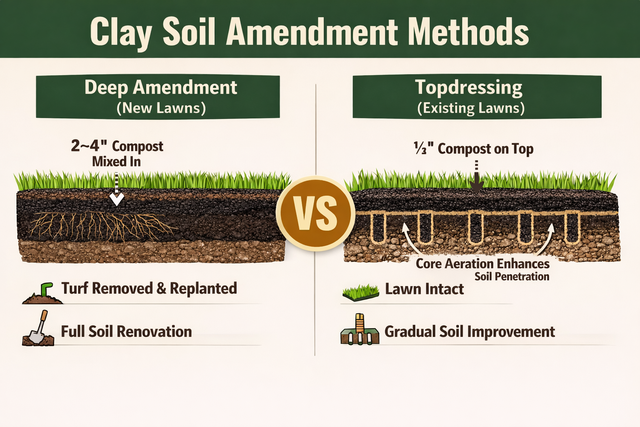
For new lawns, spread 1 to 2 inches of compost and till into the top 6 inches. For established lawns, topdress with ¼ to ½ inch twice a year, in spring and fall. Work it into aeration holes for best results when growing grass in clay soil lawn.
Avoid These Common Mistakes
Some quick fixes make clay worse. Avoid these costly errors that sabotage your efforts to grow grass in clay soil lawn.
Never Mix Sand into Clay
Contrary to popular belief, adding sand creates a concrete-like mixture. The fine clay particles fill the gaps between sand grains, sealing the soil tighter than before. This is the number one mistake homeowners make when trying to improve clay soil for lawns.
Do Not Use Wood Chips on Lawns
While great for garden beds, wood chips rob nitrogen as they decompose, leading to pale, weak grass. Save them for trees and shrubs, and stick with compost for your lawn areas.
Do Not Let Clay Dry Out Completely
Dry clay crusts over, forming an impermeable layer. Once cracked, it repels water like pavement. Keep your clay soil consistently moist during establishment to prevent this damaging cycle.
Choose the Right Grass for Clay

Not all grasses survive in dense, heavy soil. Pick varieties with deep roots and tolerance to wet and dry extremes when growing grass in clay soil lawn.
Top Grass Types for Clay Soil
• Tall fescue: Deep roots (8+ inches), drought-tolerant, handles compaction. Ideal for transition zones
• Fine fescue: Shade-tolerant, low-maintenance, works in less compacted clay
• Bermuda grass: Aggressive spreader, heat-tolerant, survives moderate clay (best in warm climates)
• Kentucky bluegrass blends: Prefers loam but can thrive in amended clay
Heat-resistant fescues like Titan rX perform exceptionally well in clay soil lawns where heat is the biggest killer of grass.
Prepare the Seedbed Properly
Even the best seed fails in poorly prepared soil. Follow these steps for strong germination when establishing grass in clay soil lawn.
Step-by-Step Seeding Process
- Test and amend soil based on results
- Rototill 4 to 6 inches deep if starting over or dealing with severe compaction
- Spread 1 to 2 inches of compost and mix thoroughly
- Rake smooth, then firm the surface with a cultipacker or light roller
- Seed evenly using a broadcast or drop spreader
- Cover seeds lightly (1/8 to 1/4 inch) with soil or compost
- Mulch with straw to retain moisture and prevent erosion
- Water gently but consistently until germination
Cover 100% with hay and keep watering until you see new grass sprouting up through the soil.
Use Cycle-and-Soak Watering
Watering clay wrong causes runoff, puddling, and shallow roots. The solution for growing grass in clay soil lawn is cycle-and-soak watering.
How Cycle-and-Soak Works
• Run sprinklers for 3 to 4 minutes, then stop
• Wait 15 to 20 minutes for water to soak in
• Repeat 2 to 3 times per session
• Goal: Deliver 1 inch of water per week, deep into the root zone
This method prevents runoff and encourages roots to grow deeper over time, which is essential for thriving grass in clay soil lawn.
Aerate Clay Soil for Long-Term Health
Annual core aeration is non-negotiable for clay lawns. It breaks up compaction and opens pathways for air, water, and nutrients to reach grass roots.
When and How to Aerate
• Best time: Early fall or early spring during active growth periods
• Tool: Rent a core aerator; avoid spike aerators, which worsen compaction
• Frequency: Once per year, more if heavily trafficked
After aeration, topdress with compost to fill holes and feed the soil. This combination is powerful for improving clay soil lawn health.
Topdress with Compost Annually
Topdressing builds soil quality over time without tearing up your lawn. It’s a cornerstone technique for growing grass in clay soil lawn successfully.
How to Topdress Correctly
• Use ¼ inch of compost or a 50/50 mix of topsoil and compost
• Apply in spring and fall
• Spread evenly with a shovel or spreader
• Work into aeration holes if possible
This builds organic matter, improves texture, and boosts microbial life in your clay soil.
Consider Alternative Ground Covers
In extreme cases, grass may not be the best choice. Some situations call for different solutions when standard grass won’t thrive.
Plant Clover Instead of Grass
White clover fixes nitrogen, enriches soil, and tolerates compaction. It stays green longer than grass and requires less mowing. The drawback is that it can spread aggressively and may be hard to remove later.
Other Options for Problem Areas
• Creeping thyme: Drought-tolerant, fragrant, low-growing
• Perennial shrubs or fruit trees: Stabilize slopes and provide yield
• Terracing and raised beds: Ideal for hilly areas to prevent erosion
Clover handles extremely poor soil, holds steep areas well, and stays green much better than many grass varieties.
Use Specialized Products Wisely
Some products can support clay improvement, but they’re not magic. Use them as supplements to your core amendment strategy for growing grass in clay soil lawn.
Products That May Help
Earth Rite: Claims to break down clay structure. Apply in early spring, summer, and late fall. Within the year, you may notice better drainage.
Mushroom Stuff: Organic soil conditioner that helps new grass root deeply before summer heat. Apply in spring as directed.
Water-holding polymers: Products like AquaSmart absorb water and release it slowly to roots, reducing watering frequency.
Set Realistic Expectations
Growing grass in clay soil lawn isn’t fast. It’s a multi-year transformation that requires patience and consistency.
Year-by-Year Progress Timeline
• Year 1: Focus on prep, seeding, and moisture control. Expect patchy growth
• Years 2 to 3: Noticeable improvement in density and color
• Years 3 to 5: Deep roots (8+ inches), lush, resilient lawn
• Natural recovery: 3 to 15 years if left unamended
It may take a few years, but in time you can expect to find good root development in your clay soil of eight inches or more.
Final Tips for Success
Do These Things
• Test soil before amending
• Add organic matter annually
• Use cycle-and-soak watering
• Aerate every fall
• Topdress with compost 1 to 2 times per year
• Choose clay-tolerant grasses like tall fescue
• Mow high (3 to 4 inches) to shade soil and reduce stress
• Overseed thin areas each fall
• Consider clover for slopes or low-maintenance zones
Avoid These Mistakes
• Adding sand to clay
• Letting soil dry out completely
• Bagging grass clippings; mulch them instead
• Mowing too short
• Walking on wet clay
• Expecting instant results
Growing a lush lawn on clay soil is possible, but requires patience and consistent effort. You don’t need to replace clay soil; just work around it with the strategies in this guide.
Frequently Asked Questions About Growing Grass in Clay Soil Lawn
Can I add sand to improve clay soil for grass?
No, adding sand to clay soil is strongly discouraged. The fine clay particles fill the gaps between sand grains, creating a concrete-like mixture that worsens drainage and compaction. Stick with organic matter like compost instead.
How long does it take to improve clay soil for grass?
Significant improvement takes 2 to 3 years of consistent effort with organic amendments, aeration, and proper watering. A fully transformed lawn with deep roots (8+ inches) typically develops within 3 to 5 years.
What is the best grass type for clay soil?
Tall fescue is widely considered the best grass for clay soil due to its deep root system (8+ inches), drought tolerance, and ability to handle compaction. Fine fescue and Bermuda grass are also good options depending on your climate.
How often should I aerate clay soil lawn?
Aerate clay soil lawn at least once per year, preferably in early fall or early spring during active growth periods. Heavily trafficked lawns may benefit from aeration twice per year.
Does gypsum help clay soil for grass?
Gypsum only helps if your clay is dispersive (turns water cloudy when mixed without shaking). It breaks down dispersive clay by displacing sodium ions. For non-dispersive clay, gypsum provides little benefit.
Can I grow grass on red clay soil?
Yes, you can grow grass on red clay soil by adding 6 to 8 inches of high-quality compost and topsoil over the native clay, creating a growing medium for roots to thrive in well-drained conditions.
Key Takeaways for Growing Grass in Clay Soil Lawn
Growing grass in clay soil lawn requires understanding that clay presents unique challenges but also unique advantages. The dense structure holds nutrients and moisture, but it also causes compaction and drainage problems. Success comes from working with these properties rather than against them.
Focus on building organic matter through annual topdressing with compost, choosing clay-tolerant grass varieties like tall fescue, and implementing cycle-and-soak watering to encourage deep root growth. Core aeration once per year relieves compaction and opens pathways for air, water, and nutrients to reach grass roots.
Patience is your greatest tool. Expect to see meaningful improvement within 2 to 3 years, with a fully lush lawn developing over 3 to 5 years of consistent care. Start with a soil test, then amend with organic matter, select the right grass, and maintain with aeration and topdressing. Your future green lawn depends on the effort you invest today.